Once my PCT planning got underway seriously in November I realised I needed to up my game physically. Though I’d completed the SWCP in 47 days I felt very weary, had torn a calf muscle, and was dragging my heels towards the end. The PCT is four times longer.
Scouting around online I found Lee from Trailside Fitness – an ex PCT thruhiker who is also a physical trainer with a program specifically for long distance hikers. He claims to improve the hike completion success rate of his clients, from not dropping out because of injury, three fold. With my risk assessment hat on this seemed good odds – I could have a 75% chance of completion based upon physical preparedness. I stumped up what at the time seemed like a lot of money for something I’d never done before – 4 months of training delivered remotely with a timezone difference of 7 hours. Me in UK, Lee in Idaho, USA.
I bought a modicum of equipment – some resistance bands and 20Kg dumbbells. My program was specific to my goals, and my weaknesses – both described by me and uncovered by Lee. Over 4 months I’ve completed over 100 sessions delivered and coached remotely using online tech. At ~£14 per session I’ve found this good value to me.
See below for the improvements I’ve made, gathered using Lee’s “Adventure Assessment”.
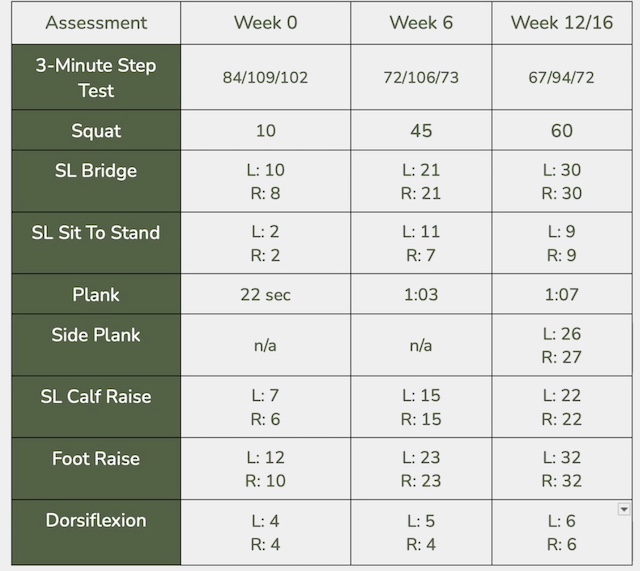
‘The three numbers in “3-minute step test” are resting heart rate, exercise heart rate, and recovery heart rate.
‘SL” is single leg.
“Foot raise” is standing with weight 50/50 each feet, the number of times I can raise the toes and foot keeping the heel on the floor.
“Dorsiflexion” is measuring ankle range of motion in inches.
Within the program I’ve progressed from
– training hikes of 16km carrying 10kg to 32km carrying 20kg.
– cardiovascular training of walking on the flat for 1 minute fast, 1 minutes slow for 1 hour, to hill climbs carrying 14kg 4 minutes up, 4 down for 1 hour.
All done with nose breathing only.
Also included in the program are a years’ subscription to Backcountry Foodie for hiker nutrition coaching, food recipes, discounts on her hiker means and advice; and 4 small group sessions with mindset coach Christina Spinazola.
Having graduated from the program Lee has provided his templates for me to continue training myself in the familiar environment. I will continue at same level for 4 weeks pushing myself hard, then have a 2 week taper before I fly out.
I leave you with this essay from Werner Erhard.
POWER
By Werner Erhard, March 21, 1983
Your power is a function of velocity, that is to say, your power is a function of the rate at which you translate intention into reality. Most of us disempower ourselves by finding a way to slow, impede, or make more complex than necessary the process of translating intention into reality.
There are two factors worth examining in our impairing velocity, in our disempowering ourselves.
The first is the domain of reasonableness. When we deal with our intentions or act to realize our intentions from reasonableness, we are in the realm of slow, impede and complicate. When we are oriented around the story or the narrative, the explanations, the justifications, we are oriented around that in which there is no velocity, no power.
Results are black and white. In life, one either has results (one’s intentions realized) or one has the reason, story, explanations, and justifications. The person of power does not deal in explanations. This way of being might be termed management by results (not management for results but management by results). The person of power manages him or herself by results and creates a space or mood of results in which to interact with others.
The other factor to be addressed is time. Now never seems to be the right time to act. The right time is always in the future. Usually this appears in the guise of “after I (or we) do so and so, then it will be the right time to act”; or “after so and so occurs, then it will be the right time to act”; or “when so and so occurs, then it will be the right time to act.” The guise includes “gathering all the facts,” “getting the plan down,” “figuring out ‘X’,” “getting ready,” etc.
Since now is the only time you have in reality and now will never seem to be the right time to act, one may as well act now. Even though “it isn’t the right time,” given that the “right time” will never come, acting now is, at the least, powerful (even if you don’t get to be right). Most people wait for the decisive moment, whereas people of power are decisive in the moment.


 New Valley Hills
Leave a reply to canadianbaconhikes Cancel reply